Speaker 1 (00:01):
It is not just about the future. It's already affecting US society ecosystems. Humans, through our burning of fossil fuels and deforestation are making extreme weather events worse, more intense and more extreme.
Speaker 2 (00:21):
The scientists are the ones who have this knowledge of what's happening to our planet right now and what the implications are going to be for humanity in the coming years and decades. We're the experts on that. And if we keep acting like there's no problem, the public isn't going to get the message.
Speaker 3 (00:42):
This is probably just a design flaw. The tar in the roof melted during a heat wave here in Glasgow, and well, this is a result and they've tried to patch it, but it's already coming out again there.
Speaker 4 (00:53):
Abstract art
Speaker 3 (00:54):
Or very big birds. Yeah. .
Speaker 4 (00:56):
I'm a human environment geographer. I've recently moved to the United States from The Bahamas, and my work looks at loss and damage. COPs for me are very emotional. I cried after Paris because I was just so overwhelmed at this disconnect between the impacts that we know are coming, particularly for small islands and this slow process that we're seeing at COP.
Speaker 5 (01:23):
I'm using International Climate change law, trying to get agreement at the international level between states. There were so many issues of equity and fairness at the heart of climate change. Those who had actually created the problem weren't the ones who were going to be on the front lines of its impacts. Two thirds of historical CO2 emissions have actually been caused by developed countries. You need an agreement that has some conscience. You need the voices of the small island states, and you need the voices of the vulnerable nations.
Speaker 6 (01:54):
I am working on energy transitions with a focus on Africa. I come from Ethiopia. If you look at African countries, their share of historic emissions is tiny, and yet the climate burden on communities is enormous.
Speaker 1 (02:12):
I came up with the idea of just using simple color stripes to represent the changes in temperature, starting from 1850 on the left to 2020 on the right, communicating the very simple message that the world is warming up. A rock band used this graphic as their backdrop for their gigs on the main stage of big festivals.
Speaker 7 (02:34):
I'm a philosopher. I work alongside some of the world's leading climate scientists,
the, the law of the sea, what ocean acidification combined with plastic pollution.
What we badly need is for climate scientists express through their actions and not just their words, what they feel and what they fear.
Speaker 1 (02:53):
We're not making changes fast enough. We are not going fast enough.
Speaker 2 (02:59):
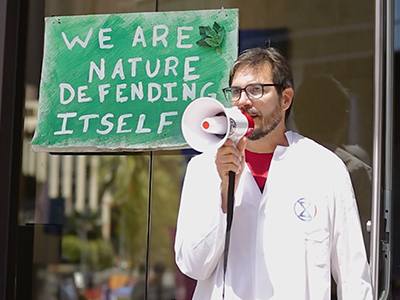
We are doing civil disobedience at JP Morgan Chase Bank, which is the one that has done the most to fund fossil fuel projects around the world. We've been warning the world for decades about earth breakdown and about global heating. And world leaders are still going in the opposite direction from where we need to go.
Speaker 7 (03:22):
Climate scientists have ownership of this issue, and so their voice has potentially enormous power. Do they undertake direct action? Do they speak absolutely truthfully to governments, to the media?
Speaker 1 (03:39):
You know, many climate scientists get very emotionally involved with what is going on. I just try and abstract myself from it, because otherwise it would be too upsetting. We have to offer hope to people. What we need to do is find ways of communicating with everybody.
Speaker 5 (04:00):
We know that what's coming is gonna be challenging. So I think all we can do is sort of build some resilience in our children. I want for him the world that I grew up in, the world in which rather than having heat waves, you know, you have stunning monsoons and beautiful mangoes in the summer that ripen at the right time.
Speaker 6 (04:19):
How are we doing on climate? I am pessimistic because of intellect, because I know what the numbers are telling us, but I also have optimism of the will.
Speaker 2 (04:31):
I'm here because scientists are not being listened to. I'm willing to take a risk for this gorgeous planet and for my sons, and we've been trying to warn you guys for so many decades that we're heading towards a catastrophe and we've been being ignored, and it's gotta stop. We're gonna lose everything. I am not really a lawbreaker. Um, but what if I had an opportunity to make some kind of difference and I didn't take it.
Speaker 5 (05:11):
I'm not alone. You know, there are dozens and hundreds of activists and sort of lawyers and and scientists that are doing this.
Speaker 8 (05:18):
What are the tactics of the group here? They're describing this action as nonviolent civil disobedience. We are not protestors. We are protectors. We are protectors.
Speaker 7 (05:28):
The responsibility on all of us at this point in history is what can you do? What can you do with your body, with your voice, with your money if you have money? There's a way in which all of us can play a key role here.
Speaker 5 (05:49):
You lead your life. You take things one day at a time. You pick up your kids from school and drop them to school. There's a larger context, which gives you some meaning and some purpose that in this existential challenge, you can actually help.